
Escaping the Cave
On the signs and realities inherent in the sacraments

The perpetual adoration chapel near my home is architected in such a manner that it communicates a number of theological truths silently and in a hidden way. It makes visible a number of invisible truths, but only to the one who puts in effort to seek them. In this chapel, the Blessed Sacrament sits elevated on an altar, held aloft by two cherubim, and flanked by two eastern icons. On the left, the Madonna and Child, seated on a throne. On the right, the Pantocrator, or Christ, Ruler of the Universe, also enthroned. Since the child is seated upon the lap of His mother in the Madonna icon, it is also an image of the Seat of Wisdom, a title for Mary. She is called the Seat of Wisdom because she bore Wisdom in her womb, nursed Wisdom at her breast, seated on her lap. The Pantocrator, though He is an image Christ as ruler, also contains symbols of teaching. Namely, He holds a great book, and His hand is extended in blessing, but even the arrangement of those fingers teaches, two for the natures of Christ, three for the Persons of the Trinity.
So, the message is that this chapel is a place to learn about God, though no homily has ever been preached here, no lecture ever given. Instead, it is a place to learn by silent contemplation. And in the middle of the night, when one is alone in that chapel (when the HVAC fan for the building kicks off), one can experience true, uninterrupted silence. One can deeply contemplate the mystery of the Eucharist, and be taught wordlessly by God.
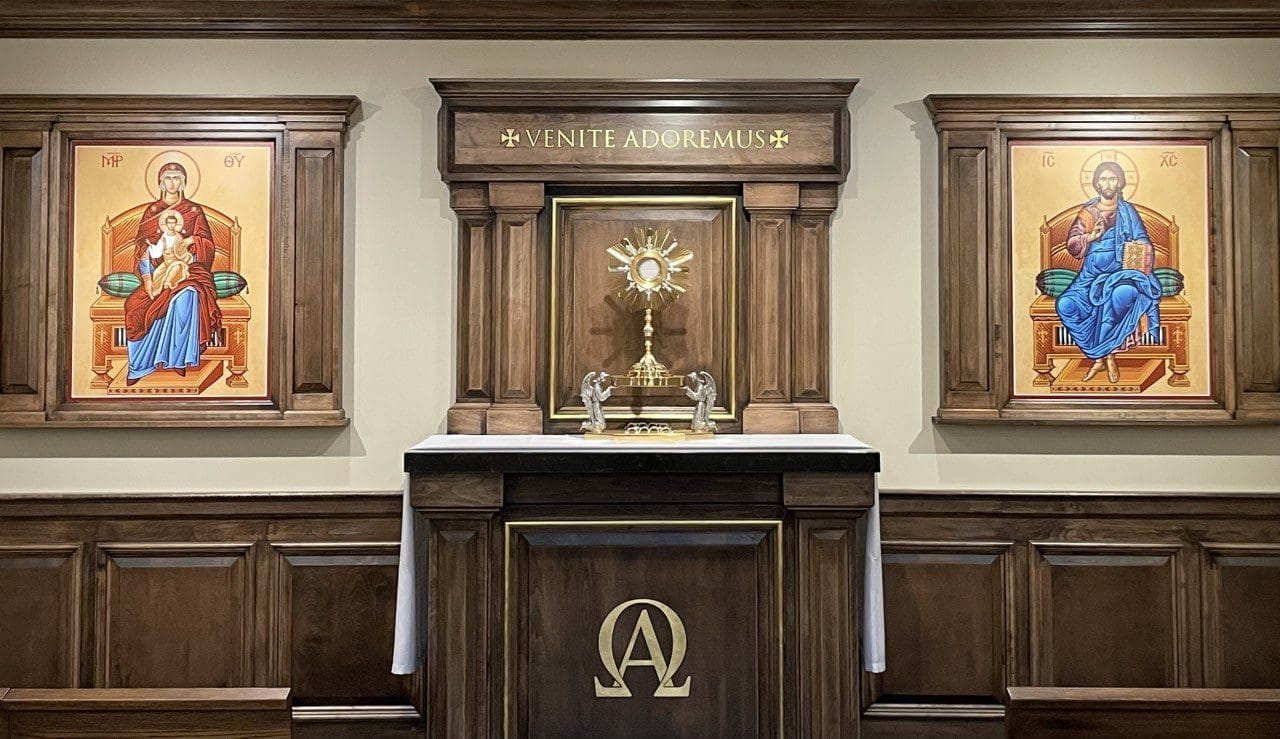
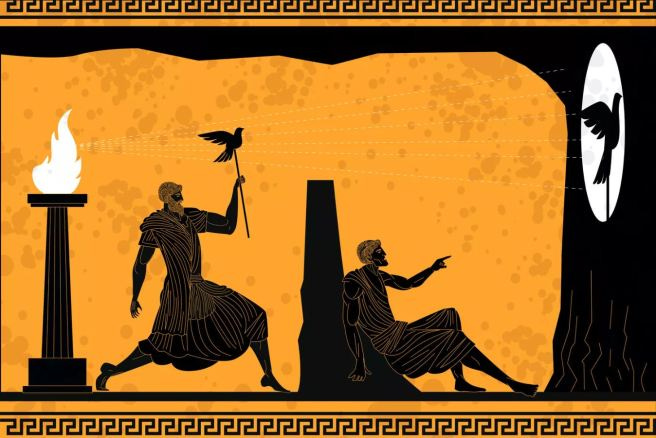
One recent late-night in adoration, I was struck by another feature of this chapel. Because of three spotlights affixed to the ceiling, the Eucharist is brightly illuminated and casts a shadow against the back wall. It reminded me of a famous philosophical analogy, Plato’s Allegory of the Cave. In the allegory, Socrates imagines a cave wherein a fire burns, and statues of things pass before the fire, casting shadows on the wall. A group of men are chained so that they can only see the wall, so, to them, the shadows are reality. But, imagine now that a man escapes his chains. He will turn around and see the statues of things as well as the fire which causes their shadows. Now he sees, the shadows are not reality, but only an image of reality.
But then, one imagines, the man escapes the cave altogether. He climbs up into the woods and fields above, and, once his eyes adjust to the bright splendor of the sun, he observes all kinds of new things. He see animals which, until now, he only knew by their shadows, or by the statues which imitated them. So, too, he sees trees, and shrubs, and all kinds of things. And, he notices, these things are all illuminated by another, greater fire, which he can barely stand to gaze upon without great pain. For Plato, this allegory illustrates what it is like to become a philosopher, a wise one, who knows truth. One begins with only the faintest ideas of things, then moves to a more solid understanding of them, and finally grasps them in reality. He comes to understand fully the idea or form of a thing. The outside area in this allegory is the world of forms, where the true natures of things are revealed. For Plato, in reality, the true natures of things are even more abstracted, being immaterial forms after which all material things are crafted. Even the living, breathing animal whose statue and shadow are in the cave is still just an imitation of the form of the animal in question, the animal in the world of forms.
There is a second part to the allegory, sometimes missed by those who present it to students, and that is the illumination of the things themselves. In the cave, it is only by a small fire the things are illuminated, and that flickering fire casts indefinite and hazy shadows upon the walls. But, above, the world is illuminated by the constant brilliance of the sun. The shadows of things on a bright, sunny day are not hazy and indefinite, but sharp and discreet. Hence, the philosopher, whose eyes are adjusted to sunlight, that is, who is comfortable in the world of forms because he has spent much time there, perceives even new ideas, the shadows, more clearly at first than does the man who sits in darkness, and who may never apprehend anything beyond the shadow at all.
As I contemplated that shadow in the adoration chapel, so distinct by the constant, unwavering spotlight, I thought of how that shadow was a sign of the sign of a sign, like the shadows on the wall of Plato's cave. The shadow is the outline or image of the monstrance, the golden vessel for exposing the Eucharist for adoration. Usually, a monstrance is modeled after the sun or a halo, with golden rays coming out from the Eucharistic Host. The monstrance is itself a sign of the Eucharist, which at last, being a Sacrament, is itself a sign of the Body and Blood of Christ. But, as Sacrament, the Eucharist is both sign and reality. It is a sign that communicates what it symbolizes of itself, and not merely in some proximate way. The Sacrament is in the world of forms. It is the real thing, only approximated by the things made in its image, the monstrance and the monstrance’s shadow, the paintings of Jesus which flank it, and the cherubim which hold it aloft. We see these images by the lights in the chapel, and see too the sign of Him in the Host by that same natural light, but the reality of the Sacrament we can see only by the light of grace, which enlightens the soul rather than the eye.
Christ is the Image of the Father, but so perfectly that He and the Father “are one,” so that He is not the Image in the way a shadow or a statue or a painting is, but an Image which of itself communicates the thing really symbolized. An encounter with Jesus is an encounter with the Father, mediated through Him, the Image. And, an encounter with the Eucharist is an encounter with Jesus, mediated through the Sacrament, His image. Through repeated encounter with Jesus, the light come into the world, one becomes as comfortable in the Light of God as in the light of the sun, so that one can see Him more and more clearly, until at last we shall see Him not as shadow nor reflection nor image, but as He truly is by grace, in the world to come.