
Is Childlessness A Blessing?
On the Words of St. Josemaria Escriva

Though it is mentioned briefly in the about section of my substack, I do not often write about the difficulty of infertility or its effects in my life. The purpose of my writing here is to share reflections on the Catholic Faith, as well as on music, philosophy, and current events insofar as they relate to the Faith, and sometimes the purpose is to teach. However, some recent experiences have led me to understand infertility in more theological terms, and I felt it would be good to write a reflection on these experiences.
My wife, Rachel, wrote a few months ago on Infertility and Spiritual Poverty, speaking of her experience as a woman wrestling with a body that refuses to do what it was made by God to do, as well as the difficulties which arise in interpersonal relationships with other Catholic families. This cross is something we have carried together at different times to different degrees and in different ways throughout six and a half years of marriage. But is is our cross to carry together, even though at times I may feel or she may feel that we are carrying it alone.
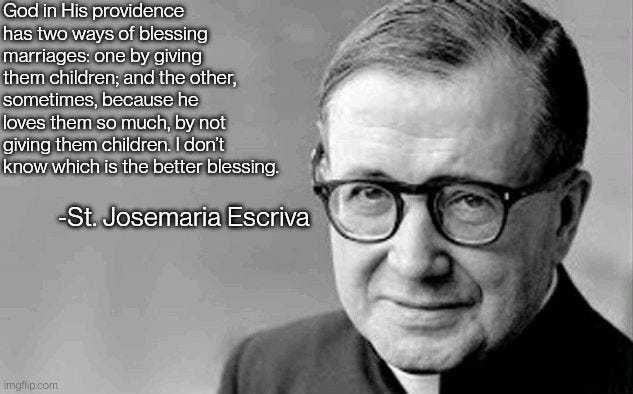
During the weekend after Easter Sunday, we attended the Catholic Infertility Conference at the National Shrine of Our Lady of Guadalupe in Lacrosse, WI, where we heard from other Catholics who have carried this cross far longer than we have. Six years seems a long time to wait for a child, but some of these couples have been infertile for ten years, eighteen years, even nearing thirty years, and have either never conceived or have conceived only ever to miscarry. That couple who had been infertile for nearly thirty years gave a formal address to the attendees on the first night, and something the husband said stuck with me. Quoting St. Josemaria Escriva, the founder of Opus Dei, a modern Catholic organization whose mission is to impress upon its members the universal call to holiness, he said “God in His providence has two ways of blessing marriage: one by giving them children; and the other, sometimes, because He loves them so much, by not giving them children. I don’t know which is the better blessing.”1
We are told over and over and over again that children are a blessing from God. I don’t mean to contradict this message; it is absolutely true. I also understand that this message is one that Christians have a duty to proclaim today, when the world is anti-child in so many ways. But for those who earnestly desire children, and yet fail again and again to conceive, or worse yet, conceive repeatedly but seem always to miscarry, this reminder is a thorn in the side. Seeing others receive this blessing while you always seem to just be waiting hurts. Rachel has likened it before to a child who sees his father give Christmas gifts to all of his children but himself. He will wonder why his father seems to love all of his siblings more then him, and what he has done to deserve being excluded from receiving his father’s blessings. If children are a blessing, then, logically, the absence of children is at least not a blessing. And, it is easy to view it as a curse.
The conference was very good for Rachel because she came to understand that the various emotions she has felt regarding our experience of infertility over the past six years are a normal and common experience for people going through this. The conference was very good for me because it helped me to deepen my relationship with suffering. A topic I have written on somewhat extensively here is Christian suffering. I have long admired the saints because of their ability to endure immense physical suffering for God. For instance, St. Lawrence the Deacon suffered his martyrdom, during which he was roasted alive, with good humor, even telling jokes to his torturers. But, recently, I’ve begun to understand that the emotional suffering of the saints is an even greater sacrifice which they offer to God. When they are persecuted and betrayed by their brothers and sisters in Christ, that is the deepest suffering they can offer to God. It is the suffering Christ endured: betrayal and abandonment by His friends.
That betrayal and abandonment are real, and though there is no abandonment nor betrayal of us by God, infertility sometimes produces the same, or at least a similar, emotional response to the experience of betrayal and abandonment. When one marries Catholic, one expects to bring new life into the world. When one is incapable of doing so, one feels that he has been betrayed by God. What is natural has been made impossible for him, and not by his own choice. When one continues to pray, to fast, to seek medical intervention, yet nothing fixes the problems, one begins to feel abandoned. One hears incessantly of miracles, yet never receives a miracle.
St. Josemaria Escriva has helped me to begin pondering the mystery of infertility as a blessing. The saints did also count themselves blessed when they suffered, and of course this is because they were more perfectly conformed to our Lord. Is it possible that He shows His great love for us in leaving our prayers unanswered? I wonder if the words of Psalm 22, “My God, my God, why have you forsaken me,” can be just as much a prayer of thanksgiving as they are an expression of sorrow.
This quote can be found in Dr. Scott Hahn’s book Ordinary Work, Extraordinary Grace: My Spiritual Journey in Opus Dei. In his end notes, Hahn references a transcript from a 1972 gathering of Opus Dei members as the source of the quotation.