
What is Worship
On the worship of the saints

When I was converting to Catholicism, I showed up one day for the RCIA1 class on Mary and the Saints. The priest who was stationed at the parish I converted in was there to talk to us about Mary. He knew me well, and we liked to joke together. I mentioned before everyone had arrived that I was excited to learn what he had to say about Mary. He responded that Catholics worship Mary, and I responded by saying, “okay, I’m out,” and pretended to get up to leave. We laughed, and he said in his serious voice “no, if that were true, I’d leave, too.” During those days, the Catholic line about Mary and the Saints was that Catholics do not worship them, but rather that we pray to them for their intercession. You see, the word pray just means to make a request of someone. You will see people addressing other human beings in older English works of fiction by saying “I pray thee” or the shortened “prithee” whenever they want to make a request of the person whom they are addressing. Of course, this made sense then. Today, I see many Catholics, including great apologists like Trent Horn, clarifying that Catholics do not indeed pray to Mary.2 I fear that this approach will cede control of the language around prayer to Protestants. Prayer, in the mind of the Protestant, now means to give the honor due to God alone, or make requests of God alone. Therefore, if one prays to the Saints, then that one is an idolator. Catholic sources which assert that we do pray to the Saints, therefore, become obsolete in the best case, and a source of scandal in the worst.
A couple of years after I went through that RCIA class, I picked up Karl Keating’s book Catholicism and Fundamentalism. This was the book that kicked off the massively successful Catholic Answers apologetics organization. The explanations of Catholic doctrine from CA employees and former employees such as Trent Horn, Tim Staples, and Patrick Madrid had heavily influenced my decision to join the Catholic Church during my RCIA experience. I want to say that I have the utmost respect for Keating and the work of Catholic Answers. In general, they are a trustworthy source for Catholics and those interested in Catholicism, and Catholicism and Fundamentalism offers very good explanations for most of the controversial points of Catholic doctrine.
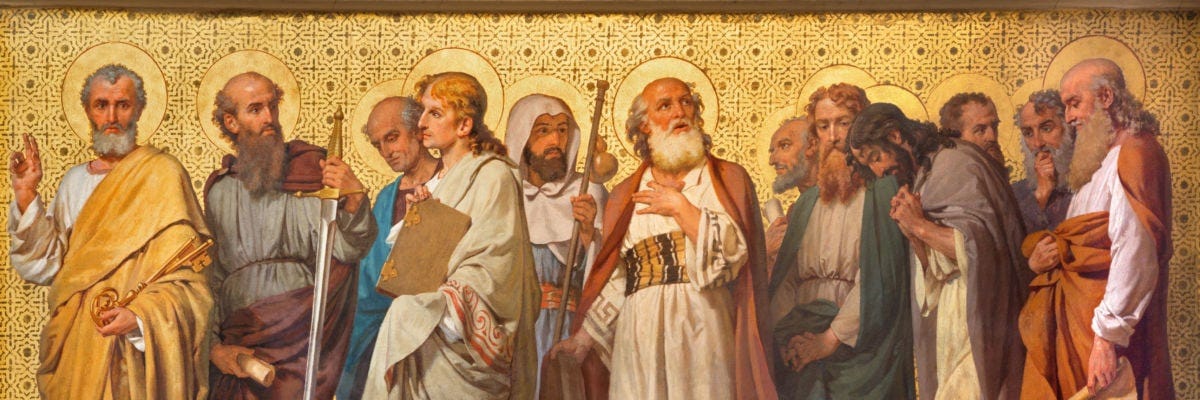
In his book, Karl Keating makes a similar argument about the word “worship” to the argument you will sometimes see from Catholic apologists today regarding the word “prayer.” Keating is a bit more forthright regarding the archaic use of the word worship in his explanation, but he still denies that the word ought to be used archaically in the presence of Protestants. In the chapter on honoring the Saints, Keating tells the story of a good priest presiding over a couple’s nuptials, at which ceremony there were both Catholics and Protestants in attendance. When the bride placed a bouquet at the feet of a statue of Mary, the priest stated that the reason for this gesture is that “we worship Mary,” to the horror, as Keating tells it, of Protestants in attendance, and the exasperation of some Catholics. Keating goes on to explain that the archaic use of the word “worship” means “to give the honor due to a person.”3 But, we of course give honors to human beings all the time because they are due such honors. We even do so for the deceased. We see that soldiers who display valor received medals such as the purple heart. Great men are honored with statues of themselves in the public square, or with streets named after them. We see also that this is the true meaning of the word worship when we consider the traditional anglo-saxon wedding vows “With this ring I thee wed; this gold and silver I thee give, with my body I thee worship and with all my worldly goods I thee endow.” No one has ever accused spouses who made these vows of idolatry.
But, if worship is paying the honor due to someone, and if we honor even secular heroes with medals and statues and street names, why shouldn’t we honor the Saints even more? After all, a secular hero has been a good man, but a Saint has been a great one. A Saint is one who is in heaven, who has lived a life of heroic virtue because of the grace of God in him, who is eternally alive in the Spirit and totally filled with grace, whose body, we know, will one day be restored and glorified. But, there is also a kind of honor which is due to God alone, and this is what worship has come to mean in the anglosphere. Over time, Protestant influence in the English-speaking world has reshaped the word worship, narrowing its meaning from general honor to the specific reverence due to God alone. Now, on account of this, older Catholic texts, which make use of the word worship in the archaic sense, will be used by the enemies of the Church to make the point that She teaches idolatry, the “worship” of the Saints.4
Because of this, it has been the standard apologist’s line to make a distinction between worship and veneration. They say we worship God and venerate the saints. That is well enough, but we need to explain what the difference is, lest we risk the Protestant mind warping the meaning of the word venerate, too. The better distinction to make would be to point out the usage of the Greek words latria and dulia. These words both mean service, and have a worshipful connotation, but are used differently in the Bible. Latria is directed exclusively to God (once or twice it is used to express pagan action towards idols). However, dulia is addressed both to God and also to men and women and even in some cases objects.5 Thus, we see that it is acceptable to honor men who really deserve it - in the natural order if on account of their own merits - or in the supernatural order if on account of God’s merits. This latter honor, honor on account of God’s merits in them, is the honor we give to the Saints. It is the dulia which the supernaturally alive deserve on account of God living in them.
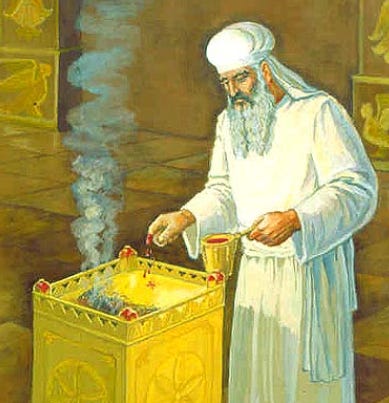
But what about latria? Can we say anything about this worship which is distinct from dulia? Indeed, we can. We ought to say that this is the worship of sacrifice, that is, ritual sacrifice in a temple or at an altar. We see plainly that, in the ancient world, both pagans and Jews worshipped in this manner. They brought sacrifices to their temples and sacrificed them to their gods, or, in the case of the Jews, to the One God, YHWH.
Much of Old Testament temple worship involved a sacrifice of an animal,6 and part of the animal was burned up while the rest was consumed. The consumption of the sacrifice was how someone actually participated in the sacrifice to YHWH. This is why it is a big deal that Hannah refuses to eat on account of her sadness in 1 Samuel (1 Sam 1:7-8). She is not participating in the sacrifice on account of her sadness due to Peninnah’s harshness. In the story we are presented with in 1 Samuel, Hannah actually does at last eat the sacrificial meal after she obtains a blessing from God through the priest Eli (1 Sam 1:17-18). We see, too, that the Jewish feast of Passover entailed worship involving a family meal, the familial eating of the sacrificial lamb. The lambs to be consumed were to be sacrificed at the temple, by a priest, then roasted and brought home by the families, where they participated in worship by eating the lamb with unleavened bread and bitter herbs, and reciting the story of Passover for everyone present to hear. We also see that concerns arose among early Christians as to whether their eating of meat sacrificed to idols in the pagan cities of the Roman Empire constituted idolatry. In these cities, such meat was often sold in markets after the sacrifice, so one may find that he purchased meat used in a sacrifice without even knowing it. Although Paul says that it does not strictly speaking constitute worship for the Christian to eat this meat, he warns against doing so because it may give the appearance of idol worship on the part of the Christian (and thus cause scandal) and also thinks that it’s a bad idea because the meat was in fact sacrificed to a demon (cf 1 Cor 8:7-13 and 1 Cor 10:18-22).
The sacrifice that we, as Catholics, offer to God is a sacrificial one. We eat of the eternal Victim when we participate sacramentally, that is, by communing, at Mass. The Orthodox Christians share in this same belief, that they eat the Victim at their Divine Liturgy. Protestants, in the vast majority of cases, even if they are liturgical, do not conceive of their participation in holy communion as a participation in sacrificial temple worship, as participation in that sacrifice which our Lord made on Calvary 2000 years ago. When we speak of the worship due to God alone, this is what we mean. We do not sacrifice animals to Mary and eat them, nor do we pour out libations or burn up grain offerings to St. Joseph. But we consume the shewbread of the Lord at Mass, the Manna come down from Heaven, the Paschal Lamb, the Body, Blood, Soul, and Divinity of our Lord, which He offered as our High Priest. All who eat His flesh and drink His blood participate in that sacrifice, just as Old Testament Jews participated in worship by having the Jewish priest make the sacrifice, and then consuming part of the meat for themselves. This is the meaning of worship, of latria. This is the honor due to God alone.
This is now called OCIA.
Here is a Protestant addressing the claim made by these Catholics about prayer. The Protestant in this case is absolutely correct that these apologists are not being honest about what the Catholic Church teaches. He also thinks we can’t pray to the Saints because they are not physically present, but he doesn’t understand that God gives infused knowledge to the Saints of the things they are to pray for (and that is what’s going on in the passage he addresses in Revelation).
Karl Keating, Catholicism and Fundamentalism. (Ignatius Press, San Francisco. 1988) p.259
This same thing, today, has happened to the word prayer. Protestants will say that prayer means making a request of God. The definition begs the questions. Of course Catholics do not “make a request of God” to Mary. That is not even something that is logically possible. But, we do pray to her. We ask her for things.
A good Orthodox apologist outlines this biblical distinction in some detail contra James White here: https://orthodoxchristiantheology.com/2017/12/29/debunking-james-white-on-the-latria-and-dulia-distinction/
There were also grain offerings and, notably, the shewbread which was also offered through eating.
Love this!